AI can write birthday messages in seconds—but most of them feel flat, predictable, and easy to forget. You’ve probably read those perfectly worded lines that sound nice at first… but don’t actually say anything real. That’s the issue. When everyone uses the same tools, everything starts to sound the same.
What actually makes a birthday message land isn’t how polished it is. It’s how real it feels. A small detail. A shared memory. Even a random inside joke. Those are the things that instantly make someone pause and smile.
In this guide, you’ll learn how to write birthday messages that don’t feel robotic—even if you use AI as a starting point. The goal is simple: make your words sound like you, not like a machine.
Why Birthday Messages Don’t Feel the Same Anymore
Birthday messages used to feel personal—even when they were short, messy, or written in a rush. Now, a lot of them sound polished but empty. That shift didn’t happen overnight. It came quietly, with tools that made writing faster but less thoughtful.
People still appreciate getting a message. That hasn’t changed. But they do notice when it feels low-effort. A perfectly structured sentence doesn’t mean much if it feels like it could’ve been sent to anyone. The difference today isn’t better wording—it’s the real intention.
1. The Rise of AI-Generated Messages in Everyday Communication
AI tools have made it incredibly easy to generate birthday wishes in seconds. You type a few words, hit enter, and instantly get something that sounds clean, friendly, and complete. On the surface, it feels like a win—less time, less effort, same result.
But here’s the catch: when everyone relies on the same systems, the output starts to blur together. The phrasing repeats. The tone feels familiar. Over time, even well-written messages begin to feel recycled. And once you’ve seen a few of them, you can’t unsee it.
2. Why People Can Instantly Recognize “Generic” Wishes
Most generic birthday messages follow a pattern. Safe phrases. Broad compliments. Zero specifics. They say the “right” things—but nothing that actually sticks. That’s why they feel distant, even when they’re kind.
People are surprisingly good at spotting this. If a message could be copied, pasted, and sent to ten different people without changing a single word, it loses its meaning. It stops feeling like a message to them—and starts feeling like a template.
What’s missing is specificity. The tiny details. The unexpected references. The things only you would say to that one person. That’s what makes someone feel seen.
3. Emotional Gap: Convenience vs Connection
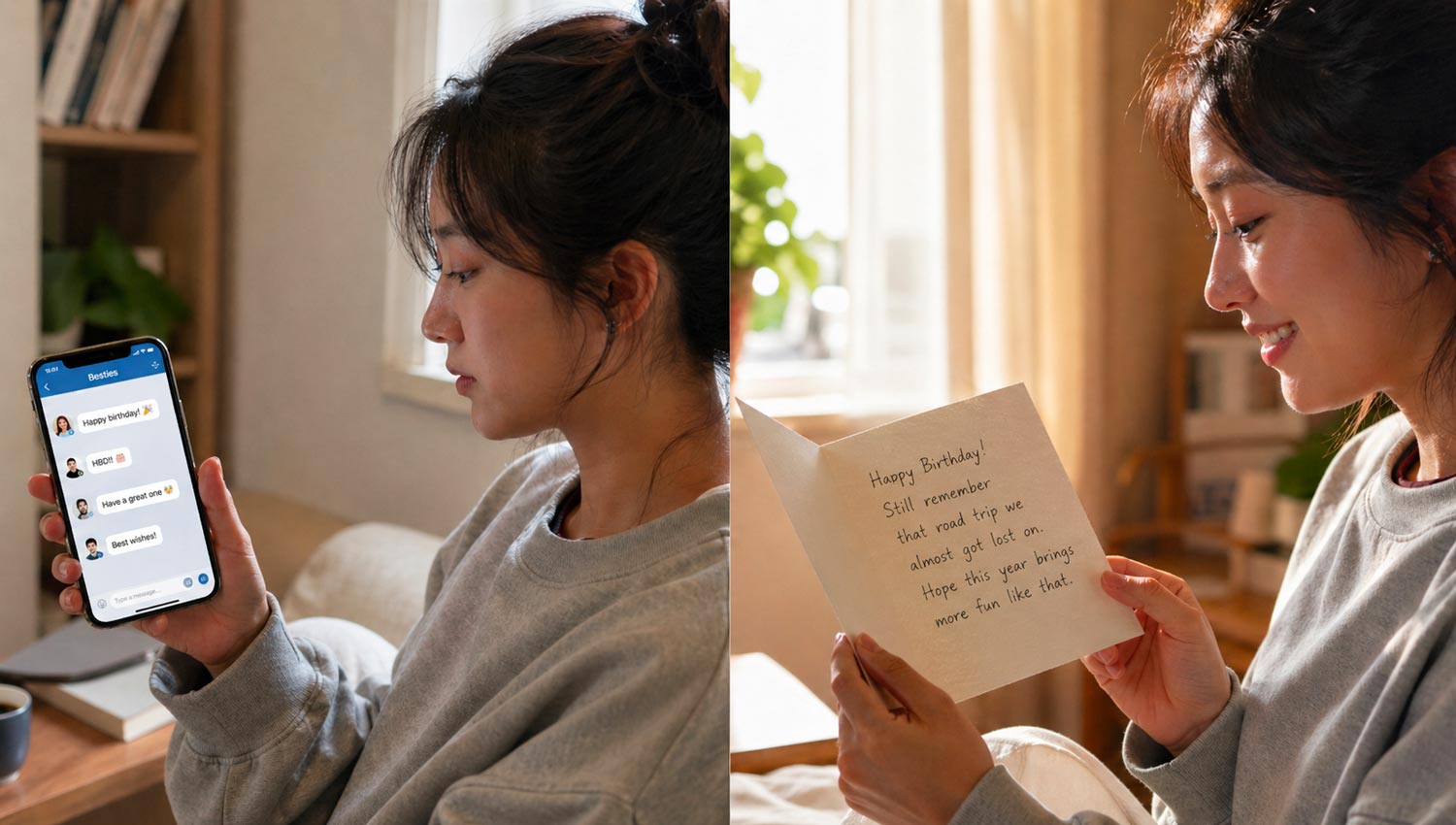
Convenience makes everything faster, but it often removes the feeling behind the message. A quick AI-generated wish can sound polished, yet it rarely carries warmth. That’s where the emotional gap starts to show.
People don’t just read words—they feel them. When a message lacks effort or personality, it becomes forgettable. A small personal touch can instantly shift a message from generic to meaningful.
Here’s how the difference really looks in practice:
| Convenience (AI-Style Message) | Connection (Human-Style Message) |
| Happy Birthday! Wishing you success and happiness always. | Happy Birthday! Still remember that road trip we almost got lost on—hope this year brings more fun like that. |
| Uses broad, safe phrases | Includes specific memories or details |
| Can be sent to anyone | Feels written just for one person |
| Focuses on sounding perfect | Focuses on feeling real |
| Quick to generate | Takes a moment to personalize |
| Emotion feels surface-level | Emotion feels genuine and warm |
| No personality or voice | Reflects your tone and style |
| Easy to forget | Easy to remember |
The goal isn’t to avoid AI completely. It’s to add your voice to it. Even one personal line can turn a simple message into something meaningful. When you focus on connection over convenience, your message doesn’t just get read—it gets remembered.
Human vs AI Tone — What’s the Real Difference?
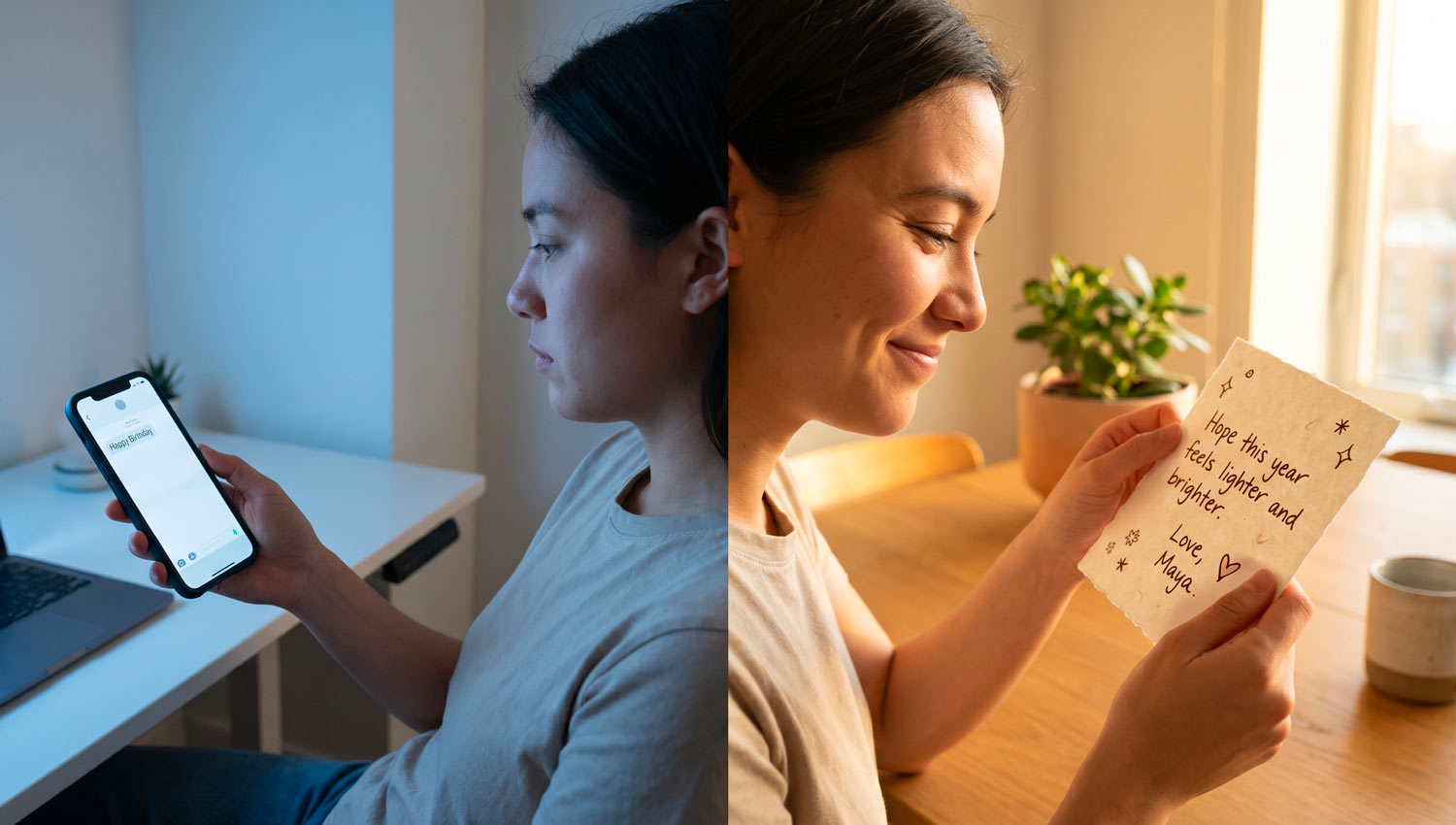
The shift in tone is subtle—but once you notice it, you can’t ignore it. You don’t always spot it instantly, yet you feel it as you read. One message sounds polished but distant. The other feels warm, familiar, and real.
This difference becomes even more obvious with birthday wishes. Some messages feel like they were generated in seconds, almost too smooth to be true. Others feel like they came from someone who actually knows you—your habits, your jokes, your random quirks. And that’s where everything changes.
What AI Messages Usually Sound Like (Common Birthday Wishes Style)
AI-generated birthday wishes usually follow a safe, predictable rhythm. They’re kind, clean, and grammatically perfect. On paper, nothing is wrong with them. But they lean heavily on overused phrases and avoid anything too specific or personal.
That’s why they feel easy to skim… and just as easy to forget.
You’ll notice a pattern quickly. These messages are designed to fit everyone, which means they don’t really land for anyone. They skip the messy, human details and stick to general compliments that feel universally acceptable.
Here’s how that usually sounds:
- 🎉 Wishing you a wonderful birthday filled with happiness and success ✨
- 🎂 May your special day bring you joy, laughter, and everything you desire 😊
- 🎈 Happy Birthday! Hope this year is full of amazing opportunities 🌟
- 🎁 Sending you warm wishes for a bright and beautiful year ahead 💫
- 🎁 Wishing you endless success and joy in the coming year 🚀
There’s nothing technically wrong with these. They’re positive. They’re polite. They say the “right” things.
But they don’t stick.
Because if you can copy, paste, and send the same message to ten different people without changing a word… it stops feeling like a message. It starts feeling like a template.
A message that fits everyone rarely feels like it’s meant for anyone.
What Makes Human Messages Stand Out (Personal Birthday Wishes That Feel Real)
Human birthday wishes land differently because they carry personality. They include small, specific details. They sound like something you’d actually say out loud—not something you carefully constructed to sound perfect.
In fact, the “imperfections” are often what make them work.
They reflect your relationship with the person—the tone you use, the shared memories you both understand, the little things no one else would mention. That’s what gives the message weight. Even a short line can feel powerful when it’s real.
Here’s the difference in action:
- 🎉 Happy Birthday! Still laughing at that one thing we said we’d never talk about again 😂
- 🎂 You make even boring days fun—today better be extra good to you 😄
- 🎈 Hope your birthday feels like a real break, not just another busy day ☕✨
- 🎁 You deserve a day where nothing annoys you… not even notifications 📱😅
- 🎉 Wishing you a year full of random wins and good surprises 🎯
- 🎂 Happy Birthday to the one who always shows up when it matters 🙌
These messages feel different because they are different.
Real always beats perfect—because perfect doesn’t feel like a person.
And that’s the core difference. AI aims for correctness. Humans aim for connection.
Simple Ways to Make Birthday Messages Feel Human
Making a birthday message feel human doesn’t mean writing something long, poetic, or overly thoughtful. In fact, the opposite usually works better. It’s about adding small, real touches that reflect an actual connection. Just a few simple tweaks can turn a basic wish into something someone actually remembers.
You don’t need to overthink it. That’s where most messages go wrong. Instead, focus on sounding like yourself—not like something that’s been edited ten times to sound “perfect.” When your message feels natural, it instantly feels more meaningful.
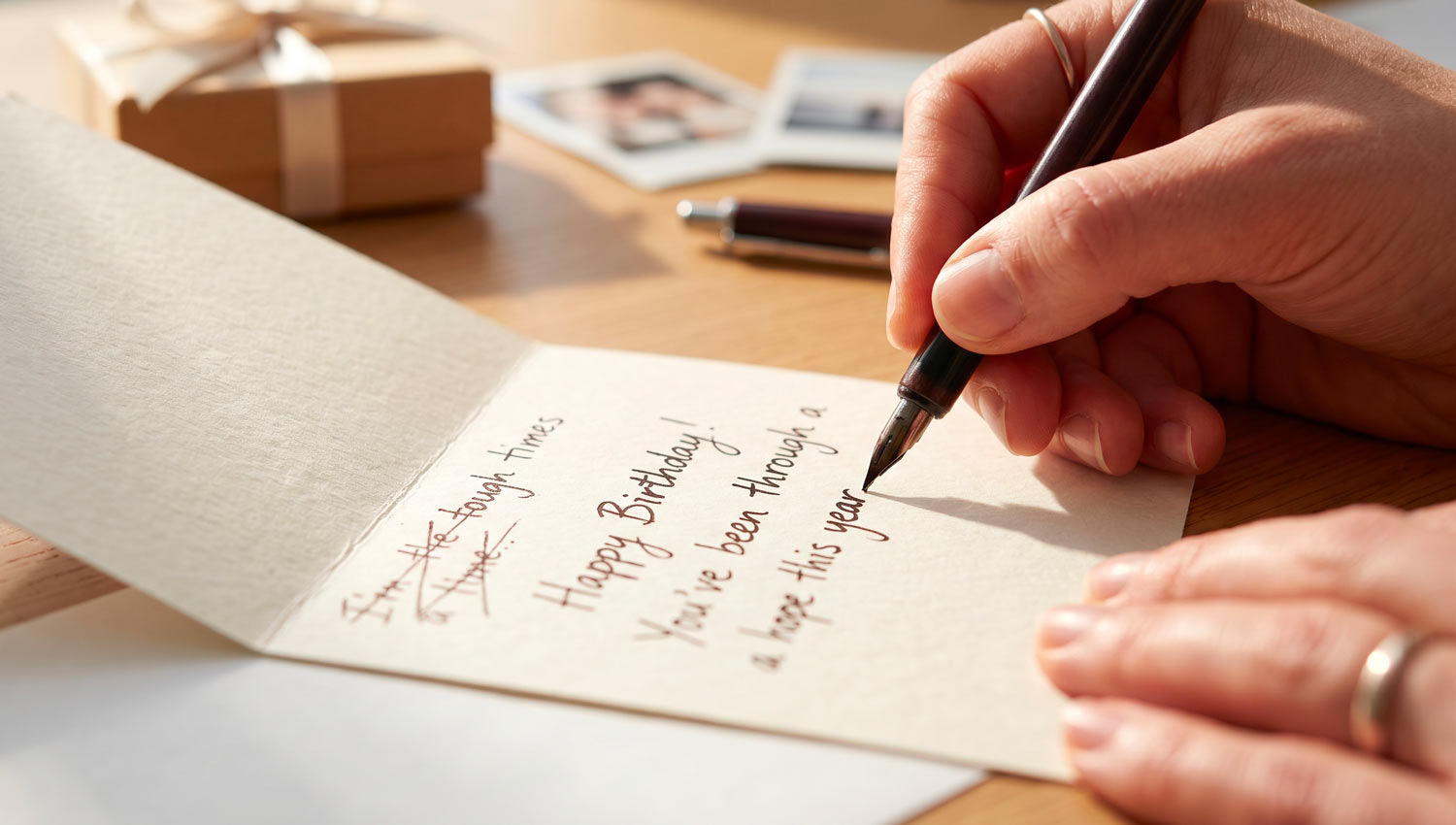
1. Start With a Specific Memory or Moment
Starting with a shared memory makes your message feel real immediately. It shows that you’re not just sending a random birthday line—you’re thinking about something you both lived through. And that changes how the message lands.
It doesn’t need to be deep or emotional. In fact, the more random or slightly chaotic, the better. A small, funny, or even mildly embarrassing moment often feels the most authentic.
Because that’s how real friendships work.
- Happy Birthday! Still thinking about that time we got lost and laughed the whole way
- Can’t forget that late-night talk we had—hope this year brings more moments like that
- Happy Birthday! Remember that random plan that actually worked out? More of that, please
These kinds of lines do something simple but powerful: they pull the person into a shared moment. Suddenly, your message isn’t just a wish—it’s a reminder of something real.
A single shared memory can make a short message feel surprisingly deep.
2. Use Their Name and Personal Details Naturally
Using someone’s name—or even a small personal detail—instantly makes your message feel more direct. It shifts the tone from “this could be for anyone” to “this is clearly for you.”
However, the key is to keep it natural. Don’t force it. If it feels awkward, it reads awkward.
Even something small—like mentioning their routine, their vibe, or something they always talk about—can make a big difference.
- Happy Birthday, Alex! Hope your day includes good food and zero stress
- Sara, you deserve a day that feels calm and happy from start to finish
- Happy Birthday, Saad! Hope today brings you real happiness
These aren’t complex messages. But they feel intentional. Because when someone sees their name—or something that reflects them—they pause for a second longer. And that pause is what makes the message stick.
People don’t remember perfect wording—they remember when something felt personal.
3. Add a Casual, Conversational Tone
A casual tone makes your message feel like a real conversation instead of a formal note. It removes that stiff, “written” feeling and replaces it with something more relaxed and familiar.
Think about how you’d actually text this person. That’s your tone.
Short sentences help. So does keeping things simple. You don’t need big words or dramatic phrasing—just something that sounds like you didn’t overthink it.
- Happy Birthday! Hope today is actually fun, not just busy
- You deserve a break from everything today—enjoy it
- Happy Birthday! Do whatever makes you happy today
This kind of tone works because it feels easy to read—and even easier to feel. It doesn’t try too hard. And because of that, it feels more real.
4. Include Imperfect but Genuine Expressions
Perfection isn’t what makes a birthday message special. In fact, trying too hard to make it perfect often does the opposite. It makes the message feel distant.
Sometimes, slightly messy or unfiltered lines feel more honest—and that’s exactly what makes them work. Because real messages aren’t always polished.
You don’t need the “perfect” sentence. You just need something that sounds like you meant it.
- Happy Birthday! I don’t even know what to write, just hope it’s a great day
- Happy Birthday! Hope everything works out for you this time
- I forgot what I planned to say, but yeah… have an amazing day
- Happy Birthday! You’ve been through a lot—hope this year feels better
These messages feel human because they don’t try to hide imperfections. They lean into it. And weirdly, that’s what makes them stronger.
Writing Birthday Messages for Different Relationships
Not every birthday message should sound the same—and honestly, people can tell when you treat them the same. The way you text a close friend is completely different from how you message a colleague or a family member. The tone shifts. The comfort level changes. Even the kind of details you include feels different.
When you match your message to the relationship, everything clicks. It feels natural, not forced. You don’t need to exaggerate emotion or overthink politeness. Just adjust your tone to reflect how you actually interact with that person.

Messages for Close Friends (Fun & Personal Birthday Wishes)
Messages for close friends are where you can relax. This is your space to be funny, slightly chaotic, and even a bit unfiltered. Inside jokes, shared experiences, and random callbacks all work here.
In fact, the less “perfect” it sounds, the better. Because this isn’t about sounding impressive—it’s about sounding like you.
- Happy Birthday! You’re still the same chaos I signed up for
- Happy Birthday! Let’s pretend we’re getting our lives together this year
- You’re the reason half my best memories exist—have the best day
- Happy Birthday! Still can’t believe how we survive our own decisions
- You make everything more fun—even the boring stuff
- Cheers to more random plans that somehow work out
- Happy Birthday! Don’t change… or maybe just a little
- You’ve been there through everything—today is all yours
These messages land because they feel familiar. They reflect your dynamic without trying to “upgrade” it into something formal or polished.
Messages for Family Members (Warm & Meaningful Birthday Wishes)
Birthday messages for family naturally carry more warmth. They lean into appreciation, support, and a sense of closeness that’s built over time. However, that doesn’t mean they need to be long or overly emotional.
Simple works—if it’s sincere. The goal here isn’t to impress. It’s to acknowledge what they mean to you in a way that feels steady and real.
- Happy Birthday! You’ve always been my support system—thank you
- Wishing you a peaceful, happy, and healthy year ahead
- Happy Birthday! Your presence makes everything feel better
- You’ve done so much for everyone—today is your day
- Hope your birthday is filled with comfort and joy
- Happy Birthday! You deserve more happiness than you ask for
- Your strength inspires me every day—enjoy your special day
- Wishing you calm moments and happy memories this year
- Happy Birthday! You make life feel stable and safe
- Happy Birthday! May this year bring you ease and comfort
These messages feel meaningful because they reflect appreciation without overcomplicating it. They’re grounded, steady, and emotionally clear.
Messages for Colleagues or Acquaintances (Polite & Friendly Birthday Wishes)
When writing for colleagues or acquaintances, the tone shifts again. Here, you want to stay friendly—but also respectful of boundaries. Too casual can feel off. Too formal can feel cold.
So the sweet spot is simple, polite, and positive. Think of it as professional warmth.
- Happy Birthday! Wishing you a great year ahead
- Hope you have a productive and happy year
- Happy Birthday! Enjoy your day and take a well-deserved break
- Wishing you success and positivity in the coming year
- Happy Birthday! Hope today brings you some well-earned relaxation
- Wishing you continued growth and great achievements
- Happy Birthday! Hope your day is smooth and enjoyable
- Wishing you a year full of progress and good moments
- Hope your day goes as smoothly as your best days at work
These messages work because they stay balanced. They show thoughtfulness without crossing into personal territory.
Final Thoughts
Birthday messages don’t need to be perfect to feel meaningful. What matters is how real they sound when someone reads them. A simple, honest line often carries more weight than a polished paragraph that feels distant.
AI can help you get started, but it shouldn’t replace your voice. The best messages come from small personal touches—something only you would say. That’s what turns a basic wish into something memorable.
Keep your messages natural. Keep them specific. Most importantly, keep you. That’s how you make birthday wishes feel human, even in the age of AI.

I’m Halima! I’m a content writer specializing in birthday articles and celebration guides. From heartfelt wishes to creative party ideas, I craft engaging content that helps people celebrate their special days in unforgettable ways.
Related Posts

Celebrating Gemini Birthdays
Birthday Wishes That Sound Like a Voice Note from a Close Friend
Funny Birthday Wishes for Pet Owners