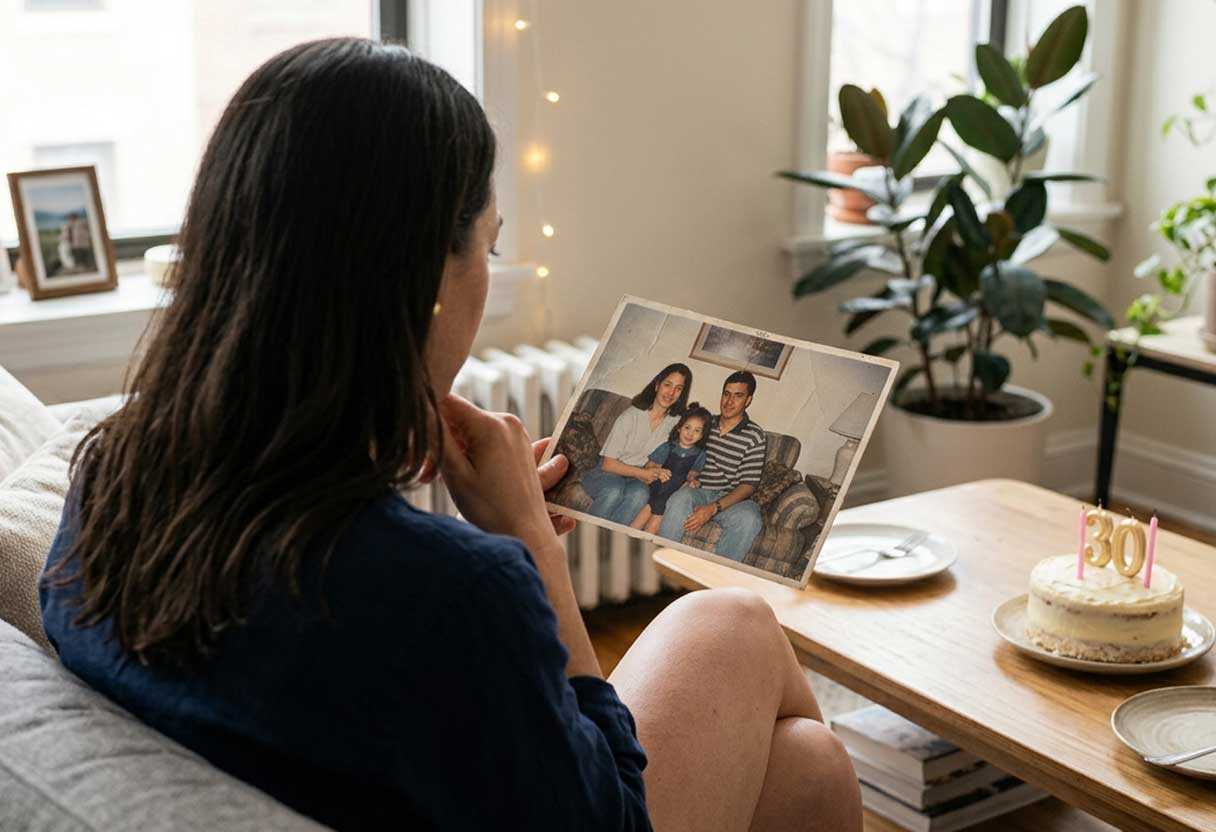
On TikTok this August, people are putting their most carefree, chaotic camera-roll clips next to a sobering comparison: “Me at the same age as my parents when they had two kids.” Often set to Pitbull’s “Hey Baby (Drop It to the Floor),” the same age as my parents trend turns a simple bit of family math into a joke with surprising emotional weight.
The humor comes from the contrast, but it raises a bigger question: Why can two people reach the same age and have lives that look nothing alike?
Birthdays make that comparison especially hard to ignore. Turning 30, for example, can suddenly become: “My mom was 30 when she had me.” That realization can change how we see adulthood, our parents, our own timeline, and even the birthday wishes we give someone who may be quietly thinking about all three.
What Is the “Same Age as My Parents” Trend?
The same age as my parents trend is a TikTok format built around one simple comparison: what your parents were doing at your current age versus what your life looks like now.
How the TikTok Trend Works
Creators usually combine casual clips from their current lives with text such as, “Me at the same age as my parents when they had two kids.” Other versions compare marriage, homeownership, careers, or other major responsibilities.
A creator might show festival footage, a night out, travel clips, or an ordinary day while remembering that a parent was raising children at exactly the same age.
SocialPilot’s August 2026 TikTok trend report lists #meatthesameage and points to creator @hope_schwing as an example of the format.
The Sound and Format Behind the Trend
A common soundtrack is Pitbull and T-Pain’s “Hey Baby (Drop It to the Floor).” The upbeat song makes the serious comparison deliberately funny: the visuals suggest one version of adulthood while the caption describes another.
Multiple August 2026 trend reports have linked the Pitbull track with the format.
There is no complicated challenge or choreography. The format works because almost anyone who knows something about their parents’ lives can adapt it.
Why the Comparison Is Resonating Now
The trend turns a familiar private thought into something visible: “They were my age when all of that was happening.”
For some people, the difference is funny. For others, it touches on deeper questions about marriage, children, housing, careers, money, and what being an adult is supposed to look like.
Its simplicity makes the comparison feel immediate, even though the circumstances behind those milestones may be very different. That wider context becomes clearer when we look at how adulthood itself has changed.
Why Reaching Your Parents’ Age Feels So Significant
Reaching an age you clearly remember your parents being can make the past feel unexpectedly close. They stop existing only as “Mom” or “Dad” and become easier to imagine as people making decisions with limited information, pressure, uncertainty, and responsibilities of their own.
When Your Parents Stop Feeling Permanently “Older”
As a child, even a modest age gap can make adults seem permanently grown-up. That changes when you reach 28, 35, or 40 and realize your parent once stood at exactly the same point on the calendar. The comparison can suddenly shrink the emotional distance between generations.
Seeing Their Life Decisions From a New Perspective
Knowing that your father changed careers at your age, or that your mother was raising a child while still building her own life, can make old family stories feel different.
You may better understand the pressures, trade-offs, and circumstances behind choices that once seemed straightforward.
That does not mean you need to make the same choices. It simply gives you a more adult view of the people who made them.
When the Comparison Goes Beyond Marriage and Children
The trend often focuses on visible milestones such as marriage and parenthood, but the comparison can reveal much more.
It can open questions about money, work, relationships, confidence, and the expectations your parents were navigating at the time.
Looking beyond visible milestones makes the comparison more revealing. Instead of asking, “Why haven’t I achieved what they had?”, you can ask, “What was their life actually like at my age?”
That is a much fairer starting point, especially because the conditions surrounding adulthood have changed considerably between generations.
Why Many Adults Reach Milestones Later Than Their Parents Did
The same-age comparison is real, but the context has changed. In the U.S., marriage, parenthood, and home buying generally happen later than they did for previous generations.
Marriage, Parenthood and Homeownership Timelines Have Changed
In 2025, the U.S. estimated median age at first marriage was 30.8 for men and 28.4 for women. In 1975, it was 23.5 and 21.1.
Parenthood has shifted too. CDC data for 2024 puts the mean age at first birth at 27.6 among U.S. mothers. Pew Research Center also found that adults ages 25–29 were substantially less likely to be married or have children than people the same age three decades earlier.
Homeownership can take longer as well. The National Association of Realtors reported that the median first-time buyer was 40 in 2025, compared with the late 20s in the 1980s.
So someone comparing themselves at 30 with a parent who married, had children, and bought a home by 30 is not comparing two typical timelines from the same period.
Economic Conditions Have Changed Too
Later milestones are not simply about people choosing to “grow up” later.
Housing affordability, rent, student debt, and the amount of time needed to save can shape major decisions. NAR says successful first-time buyers in its 2025 research cited high rent and student loans among the major costs holding them back from saving.
Education and career paths have changed as well. Pew found that young adults today are more likely to be college graduates than their counterparts three decades ago, while also being more likely to have outstanding student loans.
Your parents may have been 28 when they bought a house, but the financial conditions surrounding that decision may have looked very different.
Social Expectations Have Also Shifted
The definition of a successful adult life has become broader.
In a 2023 Pew survey, only 23% of U.S. adults said marriage was extremely or very important to a fulfilling life, and 26% said the same about having children. By comparison, 71% placed that level of importance on having a job or career they enjoy.
That does not mean marriage or parenthood matter less to everyone. It means they are no longer the only widely accepted markers of adulthood.
Someone may prioritize independence, friendships, travel, education, creative work, caregiving, or a career before—or instead of—traditional milestones.
Why Comparing Two Generations by Age Alone Can Be Misleading
A shared age can reveal an interesting contrast without making the two situations equivalent.
The trend is more useful as an invitation to understand two different versions of adulthood than as a measure of who was “ahead.” Instead of asking only, “Why haven’t I done what they had done by this age?” it can prompt a more useful question: “What did adulthood mean for them, and what does it mean for me?”
Has Adulthood Been Delayed—or Has Its Definition Changed?
Some traditional milestones now happen later, but that does not automatically mean adulthood itself has been delayed. It may be more accurate to say that adulthood has become less tied to one standard timeline.
The Traditional Adulthood Checklist
For much of the 20th century, adulthood was commonly associated with visible milestones: finishing school, getting a full-time job, leaving home, marrying, buying a house, and having children. Those milestones still matter, but they no longer define a single widely shared path into adulthood.
How Modern Adulthood Looks Different
Today, someone may spend longer in education, change careers several times, rent for longer, live with family while saving money, remain single by choice, or build a life without children.
Those paths may look less conventional without requiring less responsibility.
Adulthood today often develops through several overlapping areas: financial independence, work, relationships, caregiving, health, decision-making, and personal responsibility.
Why Responsibility Is Harder to See Than Traditional Milestones
Marriage certificates, houses, and children are easy to photograph. Other forms of adulthood are less visible.
Paying your own bills, supporting a parent, managing debt, recovering from a career setback, maintaining relationships, or making difficult long-term decisions may involve considerable responsibility without producing an obvious milestone.
Even financial independence is gradual for many young adults. In Pew’s 2023 survey, 68% of Americans ages 18–34 said they were mostly or completely financially independent from their parents, while 45% described themselves as completely independent.
That helps explain why the TikTok comparison can be misleading at first glance. Your parents’ adulthood may be easier to see because you know its major milestones. Your own may be happening in quieter ways.
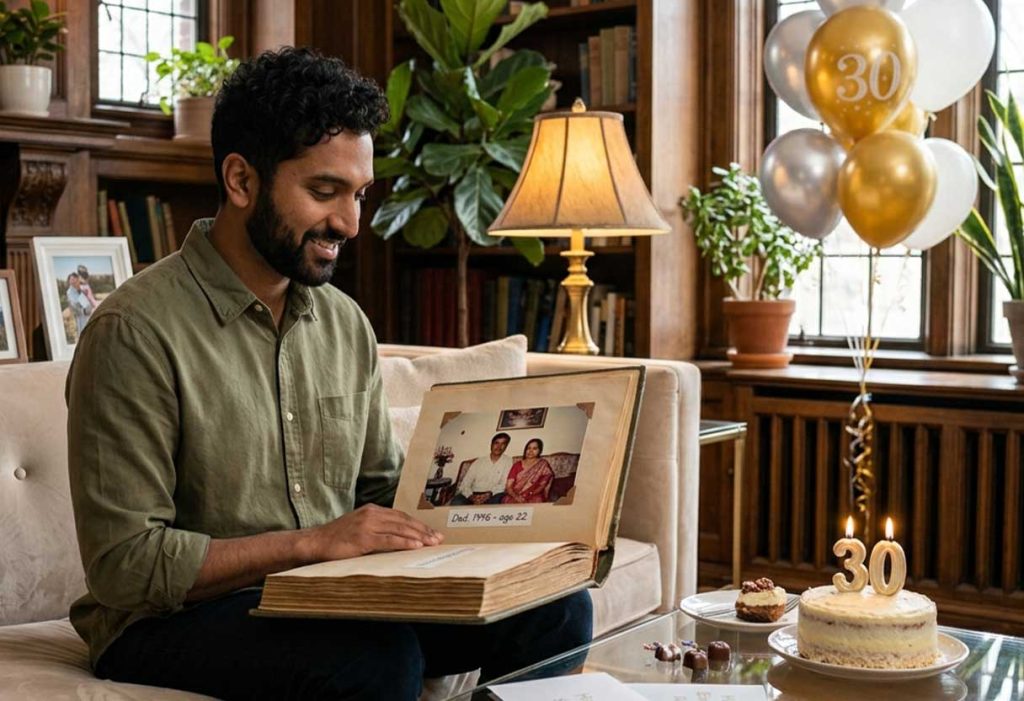
Why Birthdays Make the Same-Age Comparison Hit Harder
When a Birthday Turns Age Into a Personal Benchmark
Most days, age sits quietly in the background. A birthday puts it front and center.
That can turn a vague thought like “My parents had kids around this stage of life” into something specific: “I’m now exactly the age my dad was when I was born.”
The number has not changed your life overnight, but it gives you a clear reference point.
Why Birthdays Naturally Encourage Life Reflection
Researchers call birthdays temporal landmarks: noticeable points in time that separate one period of life from another.
A 2014 Management Science study found increases in goal-related behavior following temporal landmarks such as birthdays, new weeks, new months, new years, holidays, and the start of a new semester. The researchers called this the fresh start effect, suggesting that these moments can encourage people to step back from everyday life and take a bigger-picture view.
That helps explain why a birthday may prompt questions about where you have been and what you want next.
When “I’m 30” Becomes “My Mom Was 30 When She Had Me”
This is where the TikTok trend and birthdays naturally meet.
One birthday might put you at the age when your father changed careers; another may match the year your mother bought her first home or made a major move.
The comparison can create admiration, surprise, pressure, or even relief. It can offer perspective without prescribing what you should do next. It simply gives you a new way to understand what their life looked like at an age you now know firsthand.
Why Milestone Birthdays Can Carry Extra Emotional Weight
Round-number birthdays such as 30, 40, and 50 often feel more significant because they mark the beginning of a new decade.
Research published in PNAS found evidence across six studies that people approaching decade boundaries, such as ages 29, 39, and 49, may become more focused on questions of meaning in their lives.
The finding should not be treated as proof that everyone experiences a “milestone birthday crisis.” A later academic commentary argued that some of the patterns were open to alternative explanations and were not conclusive.
Still, it makes sense that culturally important ages can give people an extra reason to take stock.
From “What Should I Have Achieved?” to “What Does This Age Mean to Me?”
Instead of asking:
“My parents had a house and children by 32. Why don’t I?”
A better question may be:
“What matters to me at 32, given the life I’m actually living?”
Their experience can be a reference point without becoming a model you have to reproduce. It can simply help you look at both their life and yours with more clarity.
What the Same-Age Trend Gets Right—and What It Leaves Out
The trend captures a real emotional shift, but its before-and-after format compresses decades of family history into a few seconds.
Comparing Our Parents’ Milestones With Our Everyday Reality
We remember that they were married, raising children, or buying a home at 30. Meanwhile, we see ourselves ordering takeout, changing jobs, traveling, dating, or trying to save money.
But we are comparing their highlight reel in hindsight with our own life in real time.
Why Adult Responsibilities Did Not Necessarily Mean They Felt Ready
Marriage, parenthood, or homeownership may look like proof that someone had adulthood figured out, especially when viewed decades later.
But visible milestones do not tell us how confident or prepared someone actually felt at the time. Taking on a major responsibility did not necessarily mean they felt ready for it.
That distinction matters because the trend compares what their adulthood looked like with what your own adulthood feels like from the inside.
What Social Media Leaves Out of the Comparison
TikTok rewards a clear contrast. Real life is messier. A short video cannot show all the support, setbacks, compromises, financial circumstances, and private uncertainties behind a particular milestone.
That does not weaken the trend; it simply sets limits on what the comparison can tell us.
How the Same-Age Trend Can Inspire More Meaningful Birthday Wishes
The same-age comparison can make birthdays feel more reflective than usual. A thoughtful message can acknowledge that without turning someone’s age into a deadline.
Birthday Wishes for Someone Who Feels Behind
For someone feeling behind, a good birthday message should emphasize growth and possibility rather than achievement.
- Happy birthday. You don’t need to match anyone else’s timeline for this year of your life to matter.
- You’ve grown in ways that don’t always show up in milestones. I hope you give yourself credit for that today.
- Another year older, but no deadline attached. I hope this next chapter feels more like yours.
- I hope this birthday reminds you how far you’ve come, not just how far you still want to go.
Birthday Wishes for Someone Reaching the Age Their Parent Became a Parent
Reaching the age when a parent had you can make family history feel unexpectedly personal.
- Happy birthday. It’s wild to think your mom was your age when she had you. I hope it gives you a new appreciation for her and for your own completely different story.
- You’ve reached one of those ages that makes family history feel much closer. Here’s to discovering what this age means for you.
- Happy birthday to the age when your parent was figuring out parenthood, while you’re figuring out your own version of adulthood.
- Your parents’ story gives this age meaning, but you get to decide what comes next in yours. Happy birthday.
Birthday Wishes for Someone Reaching the Age Their Parents Got Married
If someone’s parents were already married at their age, the birthday can create an unexpected connection to family history.
- Happy birthday. Your parents may have been married at this age, but this chapter belongs completely to you.
- Same age, different story. I hope this year brings you the kind of life and relationships that genuinely fit you.
- It’s funny how an age can suddenly make family history feel personal. Wishing you a year shaped by your choices, not anyone else’s timeline.
- May this age bring you good people, good decisions, and more confidence in your own path.
Birthday Wishes for Milestone Ages
Milestone birthdays often bring extra reflection. The best wishes celebrate the significance of the age without suggesting that a person should have reached certain goals by now.
- Happy 30th. You don’t need a finished plan. You just need a life that keeps feeling more like your own.
- Happy 40th. May this decade bring more clarity about what deserves your time and less concern about what doesn’t.
- You’ve reached a big number, but there is still plenty of room to change direction, start again, or want something new.
- Happy birthday. I hope this next chapter feels less about proving yourself and more about enjoying what you’ve built.
- Another decade begins. Keep what matters, leave what doesn’t, and make the next years unmistakably yours.
Birthday Wishes From Parents to Adult Children
Parents can make milestone birthdays especially meaningful by sharing pride without comparing their child’s life with their own. The message should communicate trust in the person they have become.
- Happy birthday. At your age, my life looked very different, and I’m proud that you’re creating a life that belongs to you.
- Watching you become your own person has been one of the greatest parts of being your parent. I’m proud of you today and always.
- You never have to follow my timeline to make me proud. I hope you keep choosing the life that feels right for you.
- My wish for you is not that you repeat my choices, but that you trust yourself when making your own.
Questions to Ask Your Parents When You Reach the Age They Once Were
Reaching an age your parents once were can be a reason to ask about the parts of their lives that family stories and photographs do not capture.
- What did you think your life would look like at this age?
- What worried you most at the time?
- Did you feel financially secure, or were you figuring things out as you went?
- How did you feel about your job or career then?
- What expectations did your family or culture place on you?
- How confident did you actually feel about the decisions you were making?
- What were your closest relationships like at that age?
- If you were raising children then, what surprised you most about parenthood?
- What did you spend money on, and what did you struggle to afford?
- Was there anything you felt pressured to achieve by that age?
- What decision from that period are you most grateful you made?
- What do you wish you had worried about less?
- Is there anything you would do differently if you could return to that age?
- What advice would you give your younger self?
- What do you think is easier or harder about being my age today?
Their answers may reveal what the TikTok comparison cannot: adulthood that looks settled in hindsight may have felt far less certain while they were living it.

I’m Halima! I’m a content writer specializing in birthday articles and celebration guides. From heartfelt wishes to creative party ideas, I craft engaging content that helps people celebrate their special days in unforgettable ways.
Related Posts

Budget-Friendly Birthday Surprises That Show You Care
Happy 9th Birthday: Tips for a Fantastic Party
Digital vs. Handwritten Birthday Cards: Which Feels More Personal?